
| Datasheet legend
Ab/c: Fractions calculation
AC: Alternating current BaseN: Number base calculations Card: Magnetic card storage Cmem: Continuous memory Cond: Conditional execution Const: Scientific constants Cplx: Complex number arithmetic DC: Direct current Eqlib: Equation library Exp: Exponential/logarithmic functions Fin: Financial functions Grph: Graphing capability Hyp: Hyperbolic functions Ind: Indirect addressing Intg: Numerical integration Jump: Unconditional jump (GOTO) Lbl: Program labels LCD: Liquid Crystal Display LED: Light-Emitting Diode Li-ion: Lithium-ion rechargeable battery Lreg: Linear regression (2-variable statistics) mA: Milliamperes of current Mtrx: Matrix support NiCd: Nickel-Cadmium rechargeable battery NiMH: Nickel-metal-hydrite rechargeable battery Prnt: Printer RTC: Real-time clock Sdev: Standard deviation (1-variable statistics) Solv: Equation solver Subr: Subroutine call capability Symb: Symbolic computing Tape: Magnetic tape storage Trig: Trigonometric functions Units: Unit conversions VAC: Volts AC VDC: Volts DC |
|
||||||||||||||||||||||||||||||||||||||||||||||||||||||||
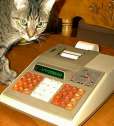
 Back in 1982, when I was a lowly conscript in the Hungarian People's (yeah, right) Army, I used to carry a beast just like this one under my arm. The story was simple: one of my superiors decided to take advantage of the resource represented by the brainpower of a few would-be engineers who were serving their mandatory one year in the Army before heading to University. I not only supposedly had the brainpower, I also had the right contacts; in particular, I had friends who were able to loan me an SR-60 desktop calculator that I took with me to the barracks on several occasions. It is for this reason alone that I decided to include an SR-60 in my collection; generally, my interest is confined to portable, battery-operated programmables, and portable the SR-60 most enthusiastically isn't!
This machine is rather huge. (In fact, the reason why it's shown in a relatively low quality photograph here is that even its keyboard is too large for my 8.5" by 13.5" flatbed scanner.) Comparable to similar desktop models from Hewlett-Packard and others, the SR-60 was several years late in coming and looked somewhat outdated even when it was new.
I have recently acquired one of these vintage machines. It was not in good working condition, but I was able to locate the cause: in addition to corroded connectors (several dozen chips in the machine are in sockets) I identified a faulty memory chip. Fortunately, the machine had optional memory modules that I was able to cannibalize to restore its base memory to good working condition.
Without the add-on memory, my SR-60 supports 480 program steps and 40 memory registers. Compared to many pocket calculators, this is a huge amount of storage (although somewhat less than the storage offered by the TI-59). Compared to even the most vintage desktop computers, it is a tiny amount. In the absence of documentation, I have not yet been able to determine how to repartition this machine's memory, even though I distinctly recall that it is possible to do so.
Despite its huge size, the SR-60 is a plain old keystroke programmable scientific calculator. Its programming model is completely unmerged; register operations, for instance, require up to 4 steps of program memory (e.g., RCL 1 0 0.) The good news is that leading zeroes can be omitted from memory indices or program addresses (in fact, when using memory 0, you don't need to type a single zero.) Programming is greatly aided by the calculator's alphanumeric display, that shows keystroke mnemonics instead of numeric keycodes.
I'd like to obtain a few magnetic cards for this machine (boy, are they ever huge!) but even in their absence, I was able to write a few test programs. One of them, of course, is a program that implements the Gamma function:
0000	LBL
0001	e1
0002	x-K
0003	1
0004	STO
0005	1
0006	x-K
0007	LBL
0008	x-K
0009	IF+
0010	GTO
0011	Π
0012	1
0013	+
0014	1
0015	=
0016	GTO
0017	x-K
0018	LBL
0019	GTO
0020	STO
0021	.
0022	1
0023	8
0024	0
0025	0
0026	9
0027	1
0028	7
0029	2
0030	9
0031	4
0032	+
0033	7
0034	6
0035	=
0036	÷
0037	(
0038	RCL
0039	+
0040	1
0041	)
0042	-
0043	(
0044	.
0045	5
0046	0
0047	5
0048	3
0049	2
0050	0
0051	3
0052	2
0053	9
0054	4
0055	+
0056	8
0057	6
0058	)
0059	÷
0060	(
0061	RCL
0062	+
0063	2
0064	)
0065	+
0066	(
0067	.
0068	0
0069	1
0070	4
0071	0
0072	9
0073	8
0074	2
0075	4
0076	8
0077	3
0078	+
0079	2
0080	4
0081	)
0082	÷
0083	(
0084	RCL
0085	+
0086	3
0087	)
0088	-
0089	(
0090	.
0091	2
0092	3
0093	1
0094	7
0095	3
0096	9
0097	5
0098	7
0099	2
0100	5
0101	+
0102	1
0103	)
0104	÷
0105	(
0106	RCL
0107	+
0108	4
0109	)
0110	+
0111	(
0112	.
0113	2
0114	0
0115	8
0116	6
0117	5
0118	0
0119	9
0120	7
0121	3
0122	9
0123	+
0124	1
0125	)
0126	÷
0127	1
0128	0
0129	0
0130	0
0131	÷
0132	(
0133	RCL
0134	+
0135	5
0136	)
0137	-
0138	(
0139	.
0140	3
0141	9
0142	5
0143	2
0144	3
0145	9
0146	3
0147	8
0148	5
0149	+
0150	5
0151	)
0152	÷
0153	1
0154	0
0155	0
0156	0
0157	x²
0158	÷
0159	(
0160	RCL
0161	+
0162	6
0163	)
0164	+
0165	1
0166	+
0167	1
0168	.
0169	9
0170	÷
0171	1
0172	0
0173	0
0174	0
0175	0
0176	0
0177	x²
0178	=
0179	×
0180	(
0181	2
0182	×
0183	π
0184	)
0185	√x
0186	÷
0187	RCL
0188	=
0189	lnx
0190	+
0191	(
0192	RCL
0193	+
0194	5
0195	.
0196	5
0196	)
0198	lnx
0199	×
0200	(
0201	RCL
0202	+
0203	.
0204	5
0205	)
0206	-
0207	RCL
0208	-
0209	5
0210	.
0211	5
0212	=
0213	ex
0214	÷
0215	RCL
0216	1
0217	=
0218	RTN
