
| Datasheet legend
Ab/c: Fractions calculation
AC: Alternating current BaseN: Number base calculations Card: Magnetic card storage Cmem: Continuous memory Cond: Conditional execution Const: Scientific constants Cplx: Complex number arithmetic DC: Direct current Eqlib: Equation library Exp: Exponential/logarithmic functions Fin: Financial functions Grph: Graphing capability Hyp: Hyperbolic functions Ind: Indirect addressing Intg: Numerical integration Jump: Unconditional jump (GOTO) Lbl: Program labels LCD: Liquid Crystal Display LED: Light-Emitting Diode Li-ion: Lithium-ion rechargeable battery Lreg: Linear regression (2-variable statistics) mA: Milliamperes of current Mtrx: Matrix support NiCd: Nickel-Cadmium rechargeable battery NiMH: Nickel-metal-hydrite rechargeable battery Prnt: Printer RTC: Real-time clock Sdev: Standard deviation (1-variable statistics) Solv: Equation solver Subr: Subroutine call capability Symb: Symbolic computing Tape: Magnetic tape storage Trig: Trigonometric functions Units: Unit conversions VAC: Volts AC VDC: Volts DC |
|
||||||||||||||||||||||||||||||||||||||||||||||||||||||||
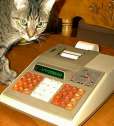
 The Elektronika MK-56 is a desktop version of that Russian workhorse, the Elektronika B3-34 calculator.
Inside a reasonably stylish case is a nice, cleanly designed interior. A small transformer supplies power; small but adequate, judging by its lukewarm temperature after several hours of continuous operation. The layout of the single circuit board is clean, assembly and disassembly is easy. Clearly, it is a machine designed to be assembled by moderately skilled workers, and designed to be field serviceable.
Like other early Russian programmables (it is, after all, functionally identical to the B3-34) the MK-56 is a surprisingly good four-stack RPN calculator. The programming model is clean, stack operation is well designed (and well documented!) much like you would expect from a Hewlett-Packard machine. Yet it is clearly not a copycat calculator; there are enough substantial differences between this and HP models to make that fact clear.
Although the MK-56 provides only 8-digit accuracy, internal algorithms are good, and trigonometric and transcendental functions usually deliver a full 8 digits of precision.
The keyboard is not very good, and not only because of its age. Tactile feedback is terrible (there is no "click"), and the keys often bounce.
RPN and a partially merged programming model made it possible for me to write a nice demonstration of the MK-56's programming model using, what else? My favorite example of course, the Gamma function. This program computes the logarithm of the Gamma function to 7+ digits of precision for both positive and negative arguments using the modified Stirling's formula. Although it doesn't use two advanced features of the MK-56: loops and indirect addressing, it does make use of conditionals and subroutines to accomplish its task without using any memory registers. Note that the calculator must be in radians mode in order for the algorithm to work correctly for negative arguments.
00	50	C/П
01	50	C/П
02	5C	x<0
03	21	21
04	0L	/-/
05	53	ПП
06	21	21
07	0L	/-/
08	14	x-y
09	18	ln
10	11	-
11	14	x-y
12	20	π
13	12	×
14	1C	sin
15	20	π
16	13	÷
17	0L	/-/
18	18	ln
29	11	-
20	52	B/O
21	04	4
22	11	-
23	5C	x<0
24	53	53
25	04	4
26	10	+
27	53	ПП
28	53	53
29	14	x-y
30	01	1
31	11	-
32	0E	B^
33	14	x-y
34	01	1
35	11	-
36	12	×
37	0 	Bx
38	01	1
39	11	-
40	12	×
41	0 	Bx
42	01	1
43	11	-
44	12	×
45	0 	Bx
46	25	Ѻ
47	18	ln
48	11	-
49	14	x-y
50	0Г	Cx
51	10	+
52	52	B/O
53	04	4
54	10	+
55	1E	B^
56	1E	B^
57	1E	B^
58	22	x²
59	22	x²
60	12	X
61	23	1/x
62	01	1
63	00	0
64	05	5
65	13	/
66	14	x-y
67	0E	B^
68	22	x²
69	12	X
70	23	1/x
71	03	3
72	00	0
73	13	/
74	11	-
75	14	x-y
76	23	1/x
77	10	+
78	01	1
79	02	2
80	13	/
81	14	x-y
82	0E	B^
83	18	ln
84	12	×
85	10	+
86	14	x-y
87	11	-
88	14	x-y
89	02	2
90	14	x-y
91	13	/
92	20	π
93	12	*
94	21	√
95	18	ln
96	10	+
97	52	B/O
As a footnote of sorts, recently (July, 2005) I received another MK-56 calculator, with a very different color scheme:

