
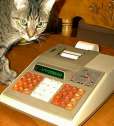
Sharp EL-5813
| Datasheet legend
Ab/c:
Fractions calculation
AC: Alternating current BaseN: Number base calculations Card: Magnetic card storage Cmem: Continuous memory Cond: Conditional execution Const: Scientific constants Cplx: Complex number arithmetic DC: Direct current Eqlib: Equation library Exp: Exponential/log functions Fin: Financial functions Grph: Graphing capability Hyp: Hyperbolic functions Ind: Indirect addressing Intg: Numerical integration Jump: Unconditional jump (GOTO) Lbl: Program labels LCD: Liquid Crystal Display LED: Light-Emitting Diode Li-ion: Li-ion rechargeable battery Lreg: Linear regression (2-var. stats) mA: Milliamperes of current Mtrx: Matrix support NiCd: Nickel-Cadmium recharg. batt. NiMH: Nickel-metal-hydrite rech. batt. Prnt: Printer RTC: Real-time clock Sdev: Standard deviation (1-var. stats) Solv: Equation solver Subr: Subroutine call capability Symb: Symbolic computing Tape: Magnetic tape storage Trig: Trigonometric functions Units: Unit conversions VAC: Volts AC VDC: Volts DC |
| ||||||||||||||||||||||||||||||||||||||||||||||||||||||||
 This little gem of a programmable calculator was an unexpected find. I wasn't even aware of this model number until one day, I had a chance to buy three of these machines. Even though only one worked out of the box, and of the other two, one was repairable (with some broken traces on its circuit board) but the other was a hopeless case of heavy corrosion, I was happy with the result: here I had in my hands a previously unknown programmable machine in good working condition.
I even know these machines' approximate age: one of the three came with a warranty sticker that dates back to 1981. Older than I'd have thought!
These machines have a 30-step program memory with no way to edit/review programs. An annoying "feature" is that when you hit the LRN key, the display is reset to 0 and pending operations are cancelled. This makes it difficult to program algorithms that operate on the displayed value, if said algorithms result in an error for an argument of zero (this would interfere with the entering of the program). Since most trivial implementations of the Gamma function or Stirling's formula fall into this category, my favorite programming example needed some adjustments before I was able to fit it into the machine's limited program memory.
A further difficulty is caused by the fact that the EL-5813 stores programs in completely unmerged form; every use of the 2ndF key takes up an extra step in program memory. Overall, however, this is not at all an unpleasant machine; its metallic case, very small size and weight, and pleasant keyboard make it an excellent shirt-pocket engineering calculator.
Stirling's formula, I said? Yes; even though the EL-5813 has several memory registers, a polynomial implementation of my programming favorite, the Gamma function, is just too much for its 30 program steps. Stirling's formula, however, does fit, even in its improved form. Note how this implementation actually increments the argument by one, which is how the problems with a zero argument can be avoided. To use the program, simply enter the argument and hit the COMP button.
x->M
1
M+
÷
RM
÷
1
2
+
1
=
×
RM
yx
RM
÷
RM
ex
×
(
2
×
2ndF
π
÷
RM
)
2ndF
√
=
