
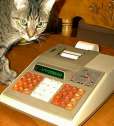
Hewlett-Packard HP-75C
| Datasheet legend
Ab/c:
Fractions calculation
AC: Alternating current BaseN: Number base calculations Card: Magnetic card storage Cmem: Continuous memory Cond: Conditional execution Const: Scientific constants Cplx: Complex number arithmetic DC: Direct current Eqlib: Equation library Exp: Exponential/log functions Fin: Financial functions Grph: Graphing capability Hyp: Hyperbolic functions Ind: Indirect addressing Intg: Numerical integration Jump: Unconditional jump (GOTO) Lbl: Program labels LCD: Liquid Crystal Display LED: Light-Emitting Diode Li-ion: Li-ion rechargeable battery Lreg: Linear regression (2-var. stats) mA: Milliamperes of current Mtrx: Matrix support NiCd: Nickel-Cadmium recharg. batt. NiMH: Nickel-metal-hydrite rech. batt. Prnt: Printer RTC: Real-time clock Sdev: Standard deviation (1-var. stats) Solv: Equation solver Subr: Subroutine call capability Symb: Symbolic computing Tape: Magnetic tape storage Trig: Trigonometric functions Units: Unit conversions VAC: Volts AC VDC: Volts DC |
| ||||||||||||||||||||||||||||||||||||||||||||||||||||||||
 I cannot really explain why, but this is one Hewlett-Packard calculator that I don't really like. Then again, it's probably not through any fault of this calculator itself: I always found the concept of a handheld device programmable in BASIC somewhat counterintuitive.
The keystroke programming model of the earliest programmable calculators was a result of necessity: the limited memory capacity and processor speed of these devices prohibited the use of a more sophisticated programming model. The point that is often missed, however, is that keystroke programming highly ergonomical! After all, although it is possible to create elaborate, complex applications for modern handheld devices (witness the many sophisticated games written for contemporary graphics calculators!) most of the time, calculator programming serves a simple purpose: to eliminate the need to repeatedly enter the keystroke sequence of a frequently used calculation.
Many keystroke programs are born this way: you perform a calculation several times, until you realize that you're growing tired of it. So you hit that P/R or LRN button, key in the sequence one more time, run a test case or two, and presto! A program is there, only to be erased a few minutes later when you have no more need for it.
For programs of this kind, a sophisticated programming language (or even a semi-sophisticated one, like BASIC) is precisely the wrong choice!
That said, as BASIC handheld calculators go, the HP-75 is a darn good device. It also has a few interesting features, in particular a motorless magnetic card reader: cards, which were preformatted with a clocking signal, were pulled through the reader by hand. The HP-75 also has extensive I/O capability through the industry standard HP-IL interface.
The BASIC used in this calculator is a fairly standard implementation. Here is yet another Gamma function program to demonstrate its use:
100 DATA 76.18009172947
110 DATA -86.50532032942
120 DATA 24.01409824083
130 DATA -1.23173957245
140 DATA 1.208650973866e-3
150 DATA -5.395239384953e-6
160 INPUT "X=? ";X
170 T=1
180 IF X>=0 THEN GOTO 220
190 T=T*X
200 X=X+1
210 GOTO 180
220 G=1.00000000019
230 FOR I=1 TO 6
240 READ P
250 G=G+P/(X+I)
260 NEXT I
270 G=LN(SQR(2*PI)*G/X)
280 G=G-X-5.5+LN(X+5.5)*(X+.5)
290 PRINT "G(X)=";EXP(G)/T
300 PAUSE