

Elektronika MK-52
| Datasheet legend
Ab/c:
Fractions calculation
AC: Alternating current BaseN: Number base calculations Card: Magnetic card storage Cmem: Continuous memory Cond: Conditional execution Const: Scientific constants Cplx: Complex number arithmetic DC: Direct current Eqlib: Equation library Exp: Exponential/log functions Fin: Financial functions Grph: Graphing capability Hyp: Hyperbolic functions Ind: Indirect addressing Intg: Numerical integration Jump: Unconditional jump (GOTO) Lbl: Program labels LCD: Liquid Crystal Display LED: Light-Emitting Diode Li-ion: Li-ion rechargeable battery Lreg: Linear regression (2-var. stats) mA: Milliamperes of current Mtrx: Matrix support NiCd: Nickel-Cadmium recharg. batt. NiMH: Nickel-metal-hydrite rech. batt. Prnt: Printer RTC: Real-time clock Sdev: Standard deviation (1-var. stats) Solv: Equation solver Subr: Subroutine call capability Symb: Symbolic computing Tape: Magnetic tape storage Trig: Trigonometric functions Units: Unit conversions VAC: Volts AC VDC: Volts DC |
| ||||||||||||||||||||||||||||||||||||||||||||||||||||||||
*EEPROM memory
 The MK-52, often described as one of the last Soviet-designed calculator (later models, like the MK-85, are obviously based on Japanese models like those made by Casio) is a uniquely capable device. To the best of my knowledge, this is the only calculator in the world that offers permanent storage in the form of an internal EEPROM module.
Most newer calculators offer permanent storage in the form of non-volatile (CMOS) memory. The contents of program and data memory (and often, even the contents of the calculator's display) are preserved when the unit is turned off. In contrast, programs and data stored on the MK-52 are lost when the calculator is powered down; however, it is possible to copy both programs and data, up to 512 bytes in total, to internal storage.
The calculator also offers two expansion ports. Programs and data in these ports is accessed in a fashion similar to the method used for accessing the internal EEPROM.
The internal EEPROM is organized as 1024 4-bit nibbles. Each program step requires 1 byte (2 nibbles) of memory; each register requires 7 bytes (14 nibbles.) When reading, clearing, or writing the EEPROM, the address and range are specified in the form of a 7-digit number, the first digit of which must be non-zero but is otherwise ignored. Address 1aaaann means nn bytes, starting at nibble address aaaa. The D-P switch controls whether data or program memory is transferred; another three-position switch is used to select read, write, and clear (apparently required before write) operations.
Take, for instance, the Gamma function program (identical to that shown for the MK-61) below. To store the contents of 7 registers (0-6) at EEPROM address 0000, followed immediately by the 84 program steps, you need to perform the following (after entering the program and the constants, of course):
- Set the three-position switch to the Clear position.
- Enter 1000049 A^ ^v
- Enter 1009884 A^ ^v
- Set the three-position switch to the Write position.
- Set the D-P switch to the Data position.
- Enter 1000049 A^ ^v.
- Set the D-P switch to the Program position.
- Enter 1009884 A^ ^v.
Afterwards, you can recall the data and the program by setting the three-position switch to the Read position, and performing steps 5-8 above.
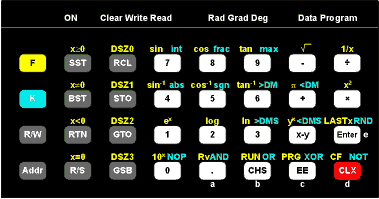 To help those who wish to use the MK-52 but find the Cyrillic labelling incomprehensible, I've created an English version of the calculator's keyboard, shown on the right. I used more or less standard English key labels, and I also reversed the labelling for conditional statements to match standard Western usage.
Reportedly, the MK-52 (equipped with special-purpose ROM modules) was also used in the Russian space program as backup in the case of on-board computer failure.
M0: 2.5066283
M1: 76.180092
M2: 86.505320
M3: 24.014098
M4: 1.2317396
M5: 1.2086510e-3
M6: 5.3952394e-6

00    0E    B^
01    01    1
02    14    <->
03    5C    x<0
04    15    15
05    0E    B^
06    25    \(\circlearrowright\)
07    12    ×
08    25    \(\circlearrowright\)
09    25    \(\circlearrowright\)
10    25    \(\circlearrowright\)
11    01    1
12    10    +
13    51    БП
14    03    03
15    47    x-П 7
16    14    <->
17    48    x-П 8
18    61    П-x 1
19    67    П-x 7
20    01    1
21    10    +
22    13    ÷
23    62    П-x 2
24    67    П-x 7
25    02    2
26    10    +
27    13    ÷
28    11    -
29    63    П-x 3
30    67    П-x 7
31    03    3
32    10    +
33    13    ÷
34    10    +
35    64    П-x 4
36    67    П-x 7
37    04    4
38    10    +
39    13    ÷
40    11    -
41    65    П-x 5
42    67    П-x 7
43    05    5
44    10    +
45    13    ÷
46    10    +
47    66    П-x 6
48    67    П-x 7
49    06    6
50    10    +
51    13    ÷
52    11    -
53    01    1
54    10    +
55    60    П-x 0
56    12    ×
57    67    П-x 7
58    13    ÷
59    18    ln
60    67    П-x 7
61    05    5
62    0-    .
63    05    5
64    10    +
65    18    ln
66    67    П-x 7
67    00    0
68    0-    .
69    05    5
70    10    +
71    12    ×
72    10    +
73    67    П-x 7
74    11    -
75    05    5
76    0-    .
77    05    5
78    11    -
79    16    ex
80    68    П-x 8
81    13    ÷
82    50    C/П
83    52    B/O
