
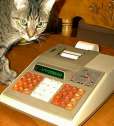
Casio PRO fx-1
| Datasheet legend
Ab/c:
Fractions calculation
AC: Alternating current BaseN: Number base calculations Card: Magnetic card storage Cmem: Continuous memory Cond: Conditional execution Const: Scientific constants Cplx: Complex number arithmetic DC: Direct current Eqlib: Equation library Exp: Exponential/log functions Fin: Financial functions Grph: Graphing capability Hyp: Hyperbolic functions Ind: Indirect addressing Intg: Numerical integration Jump: Unconditional jump (GOTO) Lbl: Program labels LCD: Liquid Crystal Display LED: Light-Emitting Diode Li-ion: Li-ion rechargeable battery Lreg: Linear regression (2-var. stats) mA: Milliamperes of current Mtrx: Matrix support NiCd: Nickel-Cadmium recharg. batt. NiMH: Nickel-metal-hydrite rech. batt. Prnt: Printer RTC: Real-time clock Sdev: Standard deviation (1-var. stats) Solv: Equation solver Subr: Subroutine call capability Symb: Symbolic computing Tape: Magnetic tape storage Trig: Trigonometric functions Units: Unit conversions VAC: Volts AC VDC: Volts DC |
| ||||||||||||||||||||||||||||||||||||||||||||||||||||||||
 Wow. Here's what the mailman brought today: one pound of calculator.
Not just any one-pounder, but quite a rarity: one of the very few magnetic card models produced back in the 1970s. Indeed, to date this is the only non-HP, non-TI magnetic card handheld in my possession. The Casio PRO fx-1 differs from its American counterparts in that its magnetic card mechanism is not motor-driven. The cards are credit-card size plastic cards with a magnetic stripe and what appears to be timing bars next to it.
At first, I thought that the card mechanism in my new-old machine was broken or worn out: I was not able to read any of the cards that came with it, but I was not able to record programs either. But then I did what I should have done in the first place and read the manual with a little bit more attention paid to the details: sure enough, I found the all-important sentence, "IT IS ESSENTIAL THAT BEFORE WRITING A PROGRAM IN THE PRO FX-1 YOU DEPRESS [AC] AND [MAC]. FAILURE TO DO SO WILL PREVENT TRANSFER OF THE PROGRAM TO A MAGNETIC CARD." The capitalization is straight from the book, and they spoke the truth: following the instructions, I can record and read cards flawlessly.
This is a beautiful machine. Its programming model is more than a bit unusual: keystroke programming that resembles high-level languages a little, for instance it has assignment statements. I was already familiar with the programming model of this beast, since it is identical to that of the fx-201P. To demonstrate how it works, here again is a copy of a program I wrote that computes the Gamma function, using Stirling's approximation and a simple iteration. The program's precision is 8+ digits for any real argument:
ENT 1 :
2 = K 1 :
ST# 3 :
IF 1 = K 9 : 1 : 2 : 2 :
ST# 1 :
2 = 2 × 1 :
1 = 1 + K 1 :
GOTO 3 :
ST# 2 :
0 = K 1 ÷ K 105 ÷ 1 ÷ 1 :
0 = K 1 ÷ K 30 - 0 ÷ 1 ÷ 1 :
0 = K 1 - 0 ÷ 1 ÷ K 12 :
0 = 1 × ln - 1 + 0 - 2 ln:
2 = K 6.2831853 ÷ 1 :
0 = 2 √ ln + 0:
ANS 0 :