
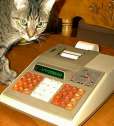
Canon FP-11P
| Datasheet legend
Ab/c:
Fractions calculation
AC: Alternating current BaseN: Number base calculations Card: Magnetic card storage Cmem: Continuous memory Cond: Conditional execution Const: Scientific constants Cplx: Complex number arithmetic DC: Direct current Eqlib: Equation library Exp: Exponential/log functions Fin: Financial functions Grph: Graphing capability Hyp: Hyperbolic functions Ind: Indirect addressing Intg: Numerical integration Jump: Unconditional jump (GOTO) Lbl: Program labels LCD: Liquid Crystal Display LED: Light-Emitting Diode Li-ion: Li-ion rechargeable battery Lreg: Linear regression (2-var. stats) mA: Milliamperes of current Mtrx: Matrix support NiCd: Nickel-Cadmium recharg. batt. NiMH: Nickel-metal-hydrite rech. batt. Prnt: Printer RTC: Real-time clock Sdev: Standard deviation (1-var. stats) Solv: Equation solver Subr: Subroutine call capability Symb: Symbolic computing Tape: Magnetic tape storage Trig: Trigonometric functions Units: Unit conversions VAC: Volts AC VDC: Volts DC |
| ||||||||||||||||||||||||||||||||||||||||||||||||||||||||
 For a long time, I wasn't even sure that this machine existed; I've heard about the FP-11P, but never found any detailed information or a picture of this interesting calculator. Now finally I hold one in my hands. A machine that is somewhat battered, with a thermal printer whose heating elements are slowly dying; nevertheless, the device still functions and I can explore its capabilities.
It didn't take very long to realize that the FP-11P is basically a printing version of another elegant Canon programmable, the F-73P. This makes the FP-11P highly unique; the only other keystroke programmable handheld calculator with built-in printer that I am aware of is Hewlett-Packard's legendary HP-19C. (All other printing models are either desktop models, or BASIC programmables.)
The functionality of the FP-11P and the F-73P is similar but not identical. Where the F-73P offers number base calculations in octal and hexadecimal, the FP-11P has printing functions. One singularly useful function is the ability to list programs on paper! Not quite the same as a true program view/edit capability, it nevertheless goes a long way towards making the calculator a really useful programmable device. (If only the printer in my FP-11P were working right!)
Curiously, printing commands cannot be included in a program. Thus, it does not appear to write a program, for instance, that automatically prints interim results and continues running.
The FP-11P suffers from the same limitations as the F-73P: only 45 partially merged program steps (most notably, steps like RCL 1 or STO 2 are NOT merged, which makes memory operations expensive) and a GOTO instruction that only allows relative jumps within nine steps of the current location makes it difficult to implement more complex algorithms. To date, my proudest accomplishment on this machine is an iterative program that computes the incomplete Gamma function:
01:  STO
02:  2
03:  RM
04:  STO
05:  1
06:  ax
07:  RCL
08:  2
09:  ÷
10:  RCL
11:  1
12:  ex
13:  ÷
14:  RCL
15:  2
16:  =
17:  STO
18:  3
19:  SM
20:  RCL
21:  3
22:  ×
23:  RCL
24:  1
25:  ÷
26:  (
27:  GOTO 1
28:  GOTO -9
29:  RCL
30:  2
31:  +
32:  1
33:  )
34:  STO
35:  2
36:  GOTO 1
37:  GOTO -9
38:  +
39:  STO
40:  3
41:  RM
42:  =
43:  x<=M 1
44:  GOTO -7
45:  RM