
| Datasheet legend
Ab/c: Fractions calculation
AC: Alternating current BaseN: Number base calculations Card: Magnetic card storage Cmem: Continuous memory Cond: Conditional execution Const: Scientific constants Cplx: Complex number arithmetic DC: Direct current Eqlib: Equation library Exp: Exponential/logarithmic functions Fin: Financial functions Grph: Graphing capability Hyp: Hyperbolic functions Ind: Indirect addressing Intg: Numerical integration Jump: Unconditional jump (GOTO) Lbl: Program labels LCD: Liquid Crystal Display LED: Light-Emitting Diode Li-ion: Lithium-ion rechargeable battery Lreg: Linear regression (2-variable statistics) mA: Milliamperes of current Mtrx: Matrix support NiCd: Nickel-Cadmium rechargeable battery NiMH: Nickel-metal-hydrite rechargeable battery Prnt: Printer RTC: Real-time clock Sdev: Standard deviation (1-variable statistics) Solv: Equation solver Subr: Subroutine call capability Symb: Symbolic computing Tape: Magnetic tape storage Trig: Trigonometric functions Units: Unit conversions VAC: Volts AC VDC: Volts DC |
|
||||||||||||||||||||||||||||||||||||||||||||||||||||||||
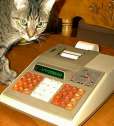
 I don't really have this peculiar calculator in my collection; however, I had it briefly in my possession, while I made an attempt to bring it back to life at the request of Andrew Davie, curator of that wonderful Internet resource, the Museum of Soviet Calculators.
Unfortunately, my attempts to repair this machine were not successful. Someone has already used this beast as a chip mine; several chips were missing, desoldered from the main circuit board. However, I was able to get at least some signs of life from the device; when I powered it up, the DC-DC converter came to life, the heating wires inside its vacuum fluorescent tubes began to glow faintly, and occasionally, a single segment in its error indicator became lit.
While taking this machine apart, I photographed its internal components.
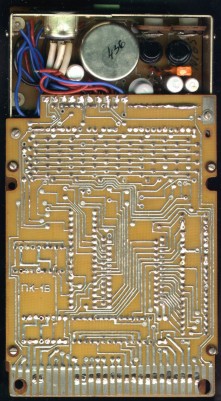 The first picture shows the insides of the machine with the back panel removed. Towards the top (which would be underneath the display) the discrete components of the machine's DC-DC converter can be seen, including what I believe to be some germanium power transistors! (I could be wrong, I only measured the parameters of these transistors in-circuit.)
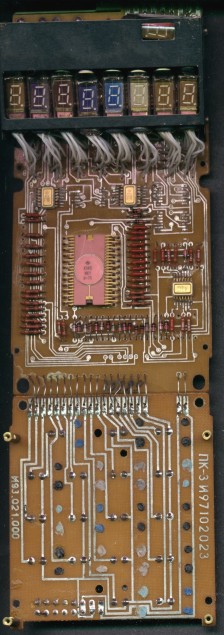 The second picture shows most of the guts of the calculator. Its two circuit boards have been opened up flat; on the picture, the board on the bottom is actually the backside of the keyboard, while the board on the top is the main CPU board. The eight display tubes, plus the ninth tube which is installed sideways and serves as an error indicator, can be easily seen. Also seen are the places where several small chips are missing (although in these relatively low-resolution JPEG images the gaps may not be obvious.)
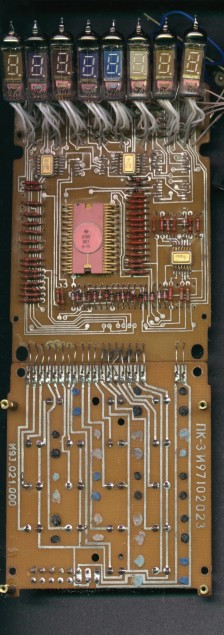 The third picture is very similar; however, by this time the display tubes have been separated from the metal enclosure that also houses the DC-DC converter beneath.
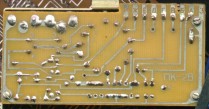 The fourth picture shows the backside of the DC-DC converter circuit panel. This side can be seen only after the housing that contains this circuit and the display tubes has been disassembled.
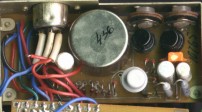 Lastly, the fifth picture shows the DC-DC converter from the component side, without being obstructed by the main circuit board.
Inside and outside, the B3-08 reeks Sharp to me. This is a machine very similar to some of the early Sharp calculators, including the EL-8M that is in my possession.
